Yesterday we had a brief discussion in class about what math is. For a bunch of math majors we came up with an explanation centered on the notion that it is a quantifiable way to explain physical phenomenon but also includes ways to predict imaginary situations. The main thing I took away from this discussion was that our definition is probably very different from most of the general population. I believe most people would consider math to be pure computations, glossing over its ability to apply to a vast amount of situations. So when the follow up question "what was the first math" was asked I thought of a different question.. I started to wonder what the first people who studied math thought it was. When did they realize this was a new subject worth studying? I imagine early civilizations didn't think of bartering at a market and traveling long distances in terms of math like we might, so it's hard to say what they thought the first math was.
Whatever the first math was, there are points in the history of math that stand out as adding great benefit to the current study of math or even the current state of the world. I'm personally intrigued by the mathematics that went into planning overseas journeys of discovery. I can't fathom figuring out how many supplies it would take to last until the ship docked again, in addition to how much weight a ship would carry if it was to return with goods. Also how to calculate times and distances of these journeys. Without all of that careful planning that no doubt took a lot of mathematical calculations we might not be in America right now. :)
In terms of the study of mathematics, Euclid made an enormous contribution by defining the components of geometry. Not only did his definitions give us the foundation to discuss geometry, but he gave us a way to prove concepts so every mathematician could easily communicate.
I also think the invention of a definite monetary system was a significant development. Although it doesn't really add the to the academic side of math, it is probably the most widely used application of math and occurs every second of the day. The idea that math is only for people who actively study it is discounting it a great deal. Even though exchanging money seems pretty basic it provides ways to talk about fractions, decimals, operations, even exponents for interest rates. And because money plays a crucial role in people's lives I think it's an important point when talking about math.
History is so rich that I find it very interesting to pull out the details concerning mathematics. Then analyzing it to see how those experiences tied into the minds and cultures of the past to influence the concept of what math was at that time intrigues me greatly. Knowing that math has changed a lot since its conception makes me wonder where it could go from here!
Wednesday, September 2, 2015

Sunday, April 5, 2015
Algebra vs. Guess-and-check
In class, we've started talking about "algebrafying" problems which is something I really enjoy, and lots of others hate. It's the process of taking a problem and expressing it in variables to find exact answers by solving for the variables. Coincidentally I had an experience with a student who I interviewed in which I thought he would use algebra to solve a problem, but he was more comfortable guessing and checking. You can see his work in the picture below.
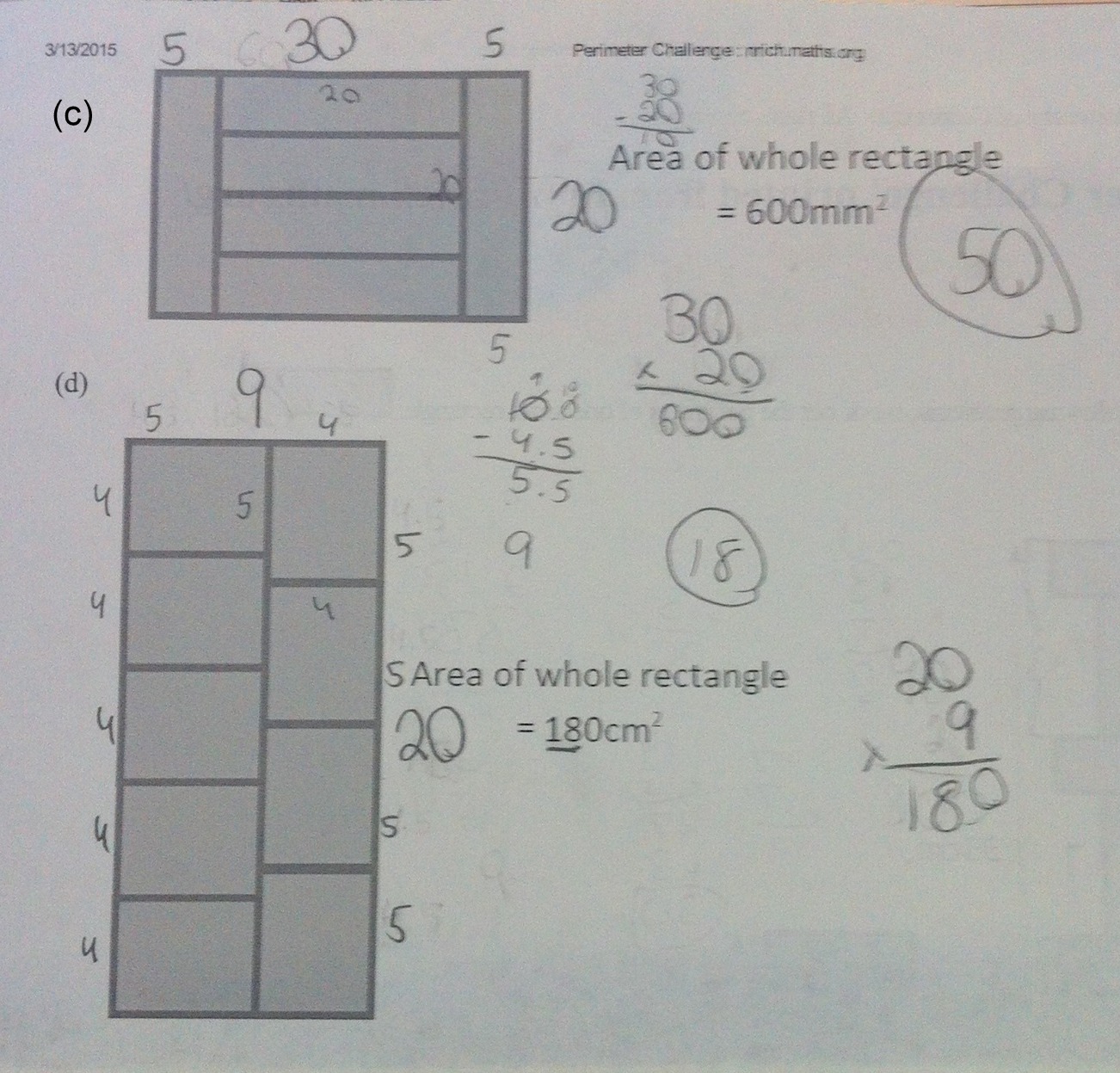
In both of these problems he tried to solve them by guessing dimensions and then checking whether they matched the picture (like 4 would visually be a smaller side than 5). Unfortunately he erased the dimensions that were wrong, so all that's left is the answer that he thought was correct. But I know from sitting with him as he worked through the problems his method was to guess dimensions, like he guessed 10x18 for the bottom picture, and then to check whether it was correct. So for the bottom one he determined 10x18 was wrong because he couldn't divide 18 (along the vertical side) into four equal integers, which represented the long side for the small rectangles.
I think this is interesting because I have learned that the most efficient way to solve a problem like this is to use algebra. So I would label the long side of each small rectangle as x and each shorter side as y and have equations like (x+y)(4x)=180 and 5y=4x, then solve for x and y to get x=5, y=4. This eliminates the possibility of having multiple guesses and having only my eyes to approximate the distances drawn. So while the student was looking at the lengths to see if his answers could make sense, his guesses would've been completely thrown off if the distances weren't drawn to scale. It could have dramatically changed his answer, whereas my answer using algebra would've remained the same and I would still be confident in my answer once I checked whether my math was correct when solving for the variables.
I also think this was eye-opening because he's in Algebra 1 and he has done problems out of the book for months now that use variables and solving systems and creating systems based on story problems. However, he was unable to apply that knowledge to these interview problems. So has he really learned how to use variables? I would lean towards no, he has not mastered the concept. He can do problems that solve for variables, but he cannot apply that to new problems which have no suggestion for how to solve them. However, to be fair it could be that he preferred to guess and check just because that's more comfortable for him and perhaps since I did not tell him how to solve it he didn't even bother with thinking about variables. Either way I think this is a great set of problems to check students understanding of variables or to even introduce the topic of variables. I knew that it wasn't fun for him to try all those different dimensions so it could be a great way to force the topic of algebra so that he could solve this problem once using variables and be done.
Tuesday, March 24, 2015
Origami and Math
This blogpost is inspired by the Ted talk by Robert Lang called The Math and Magic of Origami.
Origami is the ancient art form of folding a single sheet of paper to create objects. You can make animals, hearts, boxes, the list never ends. In fact, the amount of objects that could be made with origami exploded once people incorporated math. So why not incorporate origami in the math class?
Not only would students learn about an ancient culture, but it will teach them some properties about geometry and it will be super engaging because students will be able to make their own creation. Also, origami is great because if you mess up you just unfold it and try again. And students could probably choose their own figure to make, so it would allow for different levels of skill. In fact I could see making a project that would include a part about learning about the culture surrounding origami, then making an origami figure and explaining the math behind their figure. For example, Robert Lang talks about numbering the angles around the center circle and seeing that after folding, the odd numbered angles would add to be a line and the even numbered angles would add to be a line. I think this is super interesting and it would be interesting to ask students to find angle measures based on how many folds there are.

You could also have the students examine the crease patterns (the flat unfolded page that was once folded) and ask if there are any congruent shapes and why. Are there any similar shapes? You could also have them take a ruler to the paper and ask them area of different shapes in the crease pattern as well as perimeter. I think there are a lot of skills that could be practiced by doing this origami.
Robert Lang also discusses applications of origami in the real world. Some examples he discusses are heart stints and telescopes. I think it would be a great idea to have students work in pairs and present on a real application of origami that uses math properties that we had talked about in class.
I think this would be a really fun and engaging way to talk about shapes and geometry while learning a skill that students can be proud of. It also provides a way to learn about another culture which will help students become better citizens of the world. With the added component of researching a real life application of origami, we are also extending what we have learned and seeing how these things really matter, which is something a lot of math classes don't address. Overall, I think it's a very interesting application of math and creates such beautiful objects.
Happy folding!
Origami is the ancient art form of folding a single sheet of paper to create objects. You can make animals, hearts, boxes, the list never ends. In fact, the amount of objects that could be made with origami exploded once people incorporated math. So why not incorporate origami in the math class?
Not only would students learn about an ancient culture, but it will teach them some properties about geometry and it will be super engaging because students will be able to make their own creation. Also, origami is great because if you mess up you just unfold it and try again. And students could probably choose their own figure to make, so it would allow for different levels of skill. In fact I could see making a project that would include a part about learning about the culture surrounding origami, then making an origami figure and explaining the math behind their figure. For example, Robert Lang talks about numbering the angles around the center circle and seeing that after folding, the odd numbered angles would add to be a line and the even numbered angles would add to be a line. I think this is super interesting and it would be interesting to ask students to find angle measures based on how many folds there are.
You could also have the students examine the crease patterns (the flat unfolded page that was once folded) and ask if there are any congruent shapes and why. Are there any similar shapes? You could also have them take a ruler to the paper and ask them area of different shapes in the crease pattern as well as perimeter. I think there are a lot of skills that could be practiced by doing this origami.
Robert Lang also discusses applications of origami in the real world. Some examples he discusses are heart stints and telescopes. I think it would be a great idea to have students work in pairs and present on a real application of origami that uses math properties that we had talked about in class.
I think this would be a really fun and engaging way to talk about shapes and geometry while learning a skill that students can be proud of. It also provides a way to learn about another culture which will help students become better citizens of the world. With the added component of researching a real life application of origami, we are also extending what we have learned and seeing how these things really matter, which is something a lot of math classes don't address. Overall, I think it's a very interesting application of math and creates such beautiful objects.
Happy folding!
Friday, February 27, 2015
Decimal Pickle

In our last class we played a game called Decimal Pickle. All you need is a deck of cards with 10, Q, and K removed, and a pencil and paper! It's very simple to set up-- draw a path of ten steps, you could use circles, arrows (like I did), or any shape you want. The goal of the game is to create sort of a number line where you can place decimals in order on the path from 0 to 1. The cards you flip over on your turn are the numbers you get to arrange to form a decimal to place on the path. Red cards mean choose another card, up to three cards. Black card means stop. So for example I flip over a red Jack which represents 0, and a black 8 so I stop. Now I have two possibilities for decimals: .08 or .80. Since there are no blank arrows between .032 and .11 I cannot place .08 on my path. However, .80 is greater than .789 and less than .938, therefore I can place .80 on my last blank arrow, and I win!
A couple things to keep in mind, if you draw a decimal that is a repeat, say I draw a black 5 again, I cannot fill in two spaces with the same number. Also if there's no space for the decimal I get I must pass on that turn, for instance if I draw a red 1, and a black 2, the only possibilities are .12 or .21 which would not fit between any existing arrows, so I pass.
I think this is a great game to develop an understanding of decimal quantity. I think it especially emphasizes quantity in terms of the decimal places. For instance, it helps students learn that there's a big difference between .37 and .037 because each new decimal will have a context--it will have numbers less than and greater than the number. I also think this could be a nice intuitive introduction to start learning inequalities and their symbols, or possibly review them if they had learned about them a bit in elementary.
There is also a benefit in being a pair game because students can make mistakes in placements and the whole class won't notice, only their partner might. So there's an aspect of not only knowing your game, but also checking to make sure your partner is playing correctly. It provides lots of examples and nonexamples of appropriate placement of decimals and can involve all levels of understanding.
For us college students it really helped try to break our habit of saying "point zero six seven" which really has no mathematical meaning and instead practice saying "sixty seven thousandths" which can help set the context of decimals as fractions of tenths, hundredths, or thousandths. Pronouncing decimals as fractions can help students with the fluidity of switching between the different representations. If a student was given the fraction 7/10 they would have a much easier time creating the decimal .7 if they were used to hearing .7 as seven tenths instead of point seven.
There are some variations that can make the game more fun. My partner and I decided to increase our paths to 15 spots so it would not only take longer to fill in, but it would also make it more difficult to know how to space the decimals. Instead of having the strategy of putting .5 in the middle, you now no longer have an exact middle. So in your first couple turns when you can place your decimals in any of the blank spaces, you have to think harder about what numbers could eventually go in the spaces you leave blank.
I love strategic games, and I think this is the perfect combination of a simple game concept that can really aid learning while still having enough strategy and variations to make it fun and exciting for all types of learners.
Sunday, February 15, 2015
Levels of Understanding: Relational Vs. Instrumental
My post today is a reflection regarding the article called Relational Understanding and Instrumental Understanding by Richard Skemp. First, a quick summary. In this article Skemp discusses the two types of understanding, one could even call them levels of understanding. Relational understanding he defines as "knowing what to do and why," with an emphasis on the why aspect. Alternatively, Instrumental understanding is knowing a rule and when to use it, but not why. He calls it "rules without reason."
In the article he goes on to share a few different analogies. One was quite helpful in which he drew a comparison to music. He said instrumental understanding was like knowing the notes and the staffs on paper, but not having those figures attached to sounds. Relational understanding was like learning the notes in conjunction with the sounds. Consequently when asked to write a melody the students taught relationally, would have a far easier time writing a melody. I fully agreed with this analogy; of course reinforcing the meaning of notes with auditory information would increase the fluency and skill of students writing music. Music class would in intensely boring if nobody heard any music.
The analogy that I didn't agree with was when he compared understanding to two different ways of navigating a new city. Instrumental understanding was compared to just getting directions to and from essential places, which can lead you to be incredibly lost when you make a wrong turn. Relational understanding was like exploring the city on your own and creating a mental map so you can recognize multiple ways of getting from A to B. While I appreciate his analogy on some level, I still think it's problematic. His description of exploring the city to find your own routes relies on doing so without help from an expert. It's purely self discovery. However, I believe he wants teachers to be teaching the relationships and alternate routes to get the answer. I'm not sure that I agree with the explicit teaching of these relationships though. I think it's sort of intriguing when I don't learn every detail about a rule and then I find it out on my own when I continue learning about the subject. It s almost like an incentive to learn more so you can get the satisfaction of learning why a rule works by yourself. However, I am extremely intrinsically motivated, so I understand why not all students would have the motivation to look for connections by themselves. But I also think it's a good life lesson to not spoon feed every connection to students. They need to be able to recognize connections on their own.
As teachers perhaps we could set up questions that will inevitably lead to discovering connections, but we should leave it for them to fully explore. For example when discussing slope, many kids mix up the slope formula and divide the difference of x coordinates by the difference of y coordinates (like x/y), instead of the correct y/x. To aid the relational understanding of this topic, I could ask my students to compare slope formula to the well known trick "rise over run." Hopefully they would make the connection that the difference in y coordinates is the numerator because it corresponds to the rise. Similarly the x corresponds to the denominator because it is the run between the two x values. So this quick examination of the slope formula and what it corresponds to on a graph is a simple way to build a connection that will help students remember the slope formula. But I think it's important to not answer the question for the students, but rather pose the question and leave them to find the relationship. I think the self discovery will create independence and hopefully build some intrinsic motivation to find the relationships in upcoming lessons.
Another thing that bothers me about Skemp's outright preference for relational understanding is it's inefficiency. Even if there are a million ways to do something, I think there is something to be said about knowing how to do it with ease. I think math can be explained in so many ways, but since it values efficiency, we should teach with a preference to the efficient way to answer questions. If nobody valued efficiency, no formulas would be created. Formulas are mountains of work that are consolidated so that we can use them quickly and accurately. I think that idea is discounted in the relational understanding model, but it shouldn't be. Our students don't need to reinvent the wheel, just generally learn the concept of it so it can help them later on.
Overall I'm not completely convinced that explicitly teaching relational understanding is the best method. I think instrumental instructions has its merits as well. Relational understanding could be beneficial when students are completely struggling with a concept, or as an extra independent enrichment, but I don't think teaching instrumental tricks to help kids remember certain concepts is terrible. I think there's a time and place for both levels of understanding.
In the article he goes on to share a few different analogies. One was quite helpful in which he drew a comparison to music. He said instrumental understanding was like knowing the notes and the staffs on paper, but not having those figures attached to sounds. Relational understanding was like learning the notes in conjunction with the sounds. Consequently when asked to write a melody the students taught relationally, would have a far easier time writing a melody. I fully agreed with this analogy; of course reinforcing the meaning of notes with auditory information would increase the fluency and skill of students writing music. Music class would in intensely boring if nobody heard any music.
The analogy that I didn't agree with was when he compared understanding to two different ways of navigating a new city. Instrumental understanding was compared to just getting directions to and from essential places, which can lead you to be incredibly lost when you make a wrong turn. Relational understanding was like exploring the city on your own and creating a mental map so you can recognize multiple ways of getting from A to B. While I appreciate his analogy on some level, I still think it's problematic. His description of exploring the city to find your own routes relies on doing so without help from an expert. It's purely self discovery. However, I believe he wants teachers to be teaching the relationships and alternate routes to get the answer. I'm not sure that I agree with the explicit teaching of these relationships though. I think it's sort of intriguing when I don't learn every detail about a rule and then I find it out on my own when I continue learning about the subject. It s almost like an incentive to learn more so you can get the satisfaction of learning why a rule works by yourself. However, I am extremely intrinsically motivated, so I understand why not all students would have the motivation to look for connections by themselves. But I also think it's a good life lesson to not spoon feed every connection to students. They need to be able to recognize connections on their own.
As teachers perhaps we could set up questions that will inevitably lead to discovering connections, but we should leave it for them to fully explore. For example when discussing slope, many kids mix up the slope formula and divide the difference of x coordinates by the difference of y coordinates (like x/y), instead of the correct y/x. To aid the relational understanding of this topic, I could ask my students to compare slope formula to the well known trick "rise over run." Hopefully they would make the connection that the difference in y coordinates is the numerator because it corresponds to the rise. Similarly the x corresponds to the denominator because it is the run between the two x values. So this quick examination of the slope formula and what it corresponds to on a graph is a simple way to build a connection that will help students remember the slope formula. But I think it's important to not answer the question for the students, but rather pose the question and leave them to find the relationship. I think the self discovery will create independence and hopefully build some intrinsic motivation to find the relationships in upcoming lessons.
Another thing that bothers me about Skemp's outright preference for relational understanding is it's inefficiency. Even if there are a million ways to do something, I think there is something to be said about knowing how to do it with ease. I think math can be explained in so many ways, but since it values efficiency, we should teach with a preference to the efficient way to answer questions. If nobody valued efficiency, no formulas would be created. Formulas are mountains of work that are consolidated so that we can use them quickly and accurately. I think that idea is discounted in the relational understanding model, but it shouldn't be. Our students don't need to reinvent the wheel, just generally learn the concept of it so it can help them later on.
Overall I'm not completely convinced that explicitly teaching relational understanding is the best method. I think instrumental instructions has its merits as well. Relational understanding could be beneficial when students are completely struggling with a concept, or as an extra independent enrichment, but I don't think teaching instrumental tricks to help kids remember certain concepts is terrible. I think there's a time and place for both levels of understanding.
Friday, February 6, 2015
Fractions

This problem sparked quite the discussion about how to go about solving these problems. Of course, as college students we knew how to turn each set into fractions with common denominators, but when trying to reason through it without using fractions, we all struggled a bit.
Some of the methods we attempted was comparing how blue they were in terms of how many they would need to be all blue. So in problem B1, A would need 1 more blue and B would need 3 more blue, so A is more blue. We also attempted to "cancel out" similar containers in each set. So for B4, two blue of each set would cancel out as well as two clear, so the top would be left with 1 blue and the bottom would be left with nothing. So we argued that set A with the one blue would be more blue than set B which has nothing. This method, although seeming intuitive to some of us, caused lots of discussion amongst the class. Especially in the following problem,

Let's take problem B5 and see why canceling out doesn't fit with fractions. A= 3/5, B=4/7. Cancel out two blues so now A=1/3, B=2/5. If we just stop here we can already see that we've violated the rules of fractions since 3/5 does not equal 1/3 and 4/7 does not equal 2/5! Really, the only way we can solve this problem is by introducing fractions and being able to compare them with common denominators or by turning them into decimals. So once we reveal problems that cannot be solved without fractions, hopefully students will be more motivated to understand fractions. Without the context of fractions representing parts of wholes, it is difficult for students to comprehend the use of fractions. And without the frustration of failing to consistently solve a real world problem, students will have little motivation to learn the sometimes baffling, but important, concept of fractions.
Saturday, January 24, 2015

As I was scrolling through twitter the other day, I noticed this image with the caption "Public Education." As a future public educator, this really disappointed me because this is not how I view myself. Yes, it is common to resort to teaching the way you were taught and to teach the way you think about things, but I believe classrooms should foster creativity and innovative thinking. This can be especially hard in math because everything depends on logical reasoning which tends to be pretty straightforward. However, when there are opportunities to find creative solutions to certain problems, teachers should embrace it. This creativity should also apply to finding new teaching methods to solve problems that will help students' understanding.
Recently in MTH 329 we have been discussing using number lines to add and subtract. This is a method that I had never used before because lining up numbers vertically always worked for me. As we placed the numbered post-its on the ground and started doing some calculations by walking back and forth on our number line, I really saw the advantages of using this method. Of course, I prefer the vertical method for it's speed, but using a number line really enforced the basic concepts of adding and subtracting, especially when negative numbers are thrown into the equation. It was also great for the classroom involvement it provided. Students won't be falling asleep if they're moving around the classroom, acting out math problems.
Not only was it fun in my classroom, but it really helped a boy that I tutor. He was having trouble figuring out problems such as -4-6. I asked him if he had ever used a number line to help him solve these statements and he said none of his teachers have ever used one before. So I taught him how by drawing the number line on a page, labeling a few points, and showing him where to start and when to turn around and "walk" the other direction. I had him start at -4 facing the positive side, then since there was a subtraction (or negative sign) we turned the little arrow I had drawn around to face the negative side. Finally he walked 6 steps forward and landed at -10. He really seemed to like that he could see the numbers in front of him instead of just imagining their quantities in his head. As he worked through his homework he used his number line repeatedly and had great success with it. A week later, he even said he drew a number line on his test and it really helped! So although there's an inclination to teach how you've been taught, and to keep your thinking in a little box, it can really pay off to expand your own mind with creative new techniques that could greatly improve student learning.
Subscribe to:
Posts (Atom)