For class we each read a book of our choosing. I chose the Math Book by Clifford Pickover because it looked like an interesting quick read. The front states "250 Milestones in the History of Mathematics" and that's exactly what it is. It's written in chronological order all the way from circa 150 Million BCE to 2007, two years before it was published. Every page is a different milestone with an accompanying picture.
Not only does it discuss the famous mathematicians that we've all heard of like Pythagoras, Euler, and Fibonacci, but it also discusses people, discoveries, and inventions that I've never talked about in math class. My favorite pages were ones that talked about different puzzles and games like Rope around the Earth Puzzle (1702), and the board game Go (548 BCE) . So although not every page is a gigantic breakthrough that everyone has heard about, they're all important in some way, even just for entertainment. Most of the pages discuss some history which I found really interesting because not often do we put these discoveries in context of the times. One that I found interesting that ties in the puzzles and also history was the entry on Hex from 1942. It discussed the game of hex and how to play and then also tells about how it was manufactured by Parker Brothers. It's inventor, Piet Hein had to go into hiding in 1940 because of WWII. It really makes you think about what could have been discovered and invented by some people if their society had allowed them to keep doing math.
Overall I really enjoyed the book. It really shows how vast math is and showed how interesting it could be. It's written at a level that is easy to read and understand. I believe the general public would enjoy this book, but it might help if that have a slight interest in math to start with. No deep knowledge of math is needed to read and understand this book. For the first half of the book I read straight through in chronological order, but the second half I skipped around a bit, so if the reader decides to read in chronological order or not, either way is interesting. My only complaint is that sometimes I wish the pages were a little more in depth instead of just introducing the topic and then moving on to the next one. Perhaps if I had had more time to get through this book I could have looked up the ones I was really interested in online instead of immediately moving to the next one. I definitely liked this book though and would recommend it to anyone with the slightest inclination towards math and its history. It was an easy read and entertaining.
Wednesday, October 21, 2015

Monday, October 12, 2015
The Tale of the Cubic
Once upon a time there was no uniform way to solve all cubic functions--how sad. It was a problem that puzzled mathematicians up until 1535. What happened in 1535 you ask? Well there was a math competition in Italy that a guy named Niccolo Fontana attended. You might know him by the nickname Tartaglia which means "the stutterer." Or you might not. Anyway this guy was an engineer and amateur mathematician--because who doesn't want to do math in their free time? So he came to this competition and SURPRISE he won it by solving a cubic function using his general formula! Everyone was shocked because they had thought it to be impossible.
Since it was such a coveted formula, Tartaglia wanted to keep it to himself, even hiding it by encoding it in a poem. Here's a picture of the formula from this Vanderbilt website. Can you imagine fitting that whole thing secretly into a poem?

Since it was such a coveted formula, Tartaglia wanted to keep it to himself, even hiding it by encoding it in a poem. Here's a picture of the formula from this Vanderbilt website. Can you imagine fitting that whole thing secretly into a poem?

So Tartaglia wanted all the glory for himself and kept it a secret until the smooth talking Gerolamo Cardano came along and got the formula from Tartaglia which he subsequently published in his book "Ars Magna" in 1545. Needless to say Tartaglia was not pleased that Cardano broke his promise of keeping it a secret, but got his revenge by helping Cardano get arrested for heresy after Cardano made a horoscope for Jesus.
When we talked about the cubic formula in class I attempted to use the formula to solve the following cubic. The (-3,0), (2,0), and (5,0) are the solutions I found from graphing. My incomplete attempt gave me imaginary numbers after taking the first square root. I may have messed up a negative somewhere... But take a look and then take a moment to appreciate graphing calculators, the factor theorem, and long division of polynomials that can find the solutions a whole lot faster!

It makes me wonder what kind of applications they had that needed the solution of a cubic function. As I thought back on my schooling to try to remember an application we learned that used cubics I couldn't think of a single one. I think we were always just given a graph and/or the equation and had to find the solutions from there without giving an adequate reason why we should even solve it. So I went to google and found this page where several people came up with applications of cubics. Most of them seem to be far more advanced than what we would learn about when first seeing cubic formulas. I thought the most interesting one was the claim that the typeset letters are formed from cubic functions. So thank you cubics for helping me type this blog! Do you know of any other applications of cubic functions? Any that people would have needed in 1535?
Hey look! If you want more information about the characters in this tale click here for a more in depth story courtesy of Luke Mastin!
Sunday, September 27, 2015
Qiandu, Yangma, and the Bienao


After analyzing which sides would need to fold together I made my nets. Here's a rough sketch of each shape with the measurements. Here's a link to Jennifer's ready made nets (with a better picture).
So with my sketches, a ruler, scissors, tape and coral paper I made my nets and then folded them up to make my three shapes! Not the prettiest, but they still make a cube!
 |
| Left to Right: Bienao (1/6), yangma (1/3), and qiandu (1/2). |

As I played around with them I decided I didn't want to use the qiandu anymore, but I wanted to make two new shapes. I decided I didn't want the yangma and bienao to form another qiandu like in the original, so I positioned them kind of diagonally (pictured).

Once I got started on the nets for the two new pieces, I realized they were the exact same as the yangma and bienao. I still made them though and played around with the ways that I could put them together. This was interesting to me because I realized I couldn't put two complete faces of the same shape together. In other words I had to make two qiandus out of a yangma and bienao. I couldn't make any other formation from them that would still form a complete cube.
Overall I think it's interesting that all the way back in the third century Liu Hui was thinking about volume and how to divide it in such a way that gave a unique combination of the shapes. (You can check out a proof and more pictures here from Sherlock Holmes in Babylon: And Other Tales of Mathematical History.) Plus, I very much appreciate the kind of puzzle approach to putting it together. It makes me want to make more cubes made up of more complicated pieces, although I'm not sure if I would be able to manage making shapes that have such nice divisions of the volume like he did!
Sunday, September 13, 2015
Archimedes' Stomachion
Doing Math:
I love puzzles. Love love love them. I will spend an entire day putting together a giant jigsaw puzzles and be perfectly content. So when I saw that one of our assignment options was trying to put together Archimedes' Stomachion I was very excited! The Stomachion is basically a little 14 piece puzzle that you try to fit into a square. I did this puzzle on Geogebra which you can check out here: Stomachion on Geogebra. Make sure your window is zoomed to show all the pieces and then you can rotate them and fit them in the square!
When I started to experiment with fitting the pieces in, I tried to be methodical and fit in the biggest pieces first. With the big pieces in first, I could then see which smaller pieces could fit in between them. One of the main goals was to find out which sides of the different pieces would fit together perfectly since this would make the most of the space. At times I found it slightly difficult to spin and move the pieces exactly how I wanted them which made me wish I had physical pieces in front of me.

This was one of my first attempts. I tried to make bigger shapes out of the smaller pieces, like the yellow blue and green pieces at the top formed a triangle. This seemed like progress because it matched those ugly edges of the yellow piece up with others to make a shape that was pretty much the same as the triangle made from the long purple and green pieces. Of course the two lighter blue triangles wouldn't fit, so I knew I wasn't maximizing the space as well as I needed to.

Next decent attempt. Again I noticed certain pieces would make bigger shapes, like the rectangle in the bottom right which I kept from the first attempt. Also the square in the top right corner. However, I abandoned my first thoughts of putting in the biggest pieces first, which resulted in overlap from the red piece and vacant space around the small purple triangle.

This was my best and last attempt. If there was a way to flip over that last purple triangle, it would have fit. The right half of the square seems great. The fact that it forms a rectangle and could be cut into multiple different triangles makes me think that it is correct. However the left half doesn't have those same intracacies. Unfortunately, I could not find another way to arrange it to make it fit.
Overall this was a very fun puzzle, despite being a little frustrating at times. I always enjoy when math and puzzles connect. Interestingly enough, after I worked on this puzzle (for a long time) I was browsing through the new book I got for class (The Math Book by Clifford Pickover) and it had a page talking about Archimedes and the Stomachion. It even showed this solution, although it's not possible to make it this one in the Geogebra file without being able to reverse some pieces. I like how every piece is a part of at least two bigger triangles. Plus there is a line splitting the square into two rectangles and another line on the diagonal forming two triangles. I think it's so interesting how these strange pieces make up bigger shapes within the square. So although I didn't find one of the "17,152 solutions" it was very fun, and interesting to examine the details of a final solution.
Wednesday, September 2, 2015
What is Math?
Yesterday we had a brief discussion in class about what math is. For a bunch of math majors we came up with an explanation centered on the notion that it is a quantifiable way to explain physical phenomenon but also includes ways to predict imaginary situations. The main thing I took away from this discussion was that our definition is probably very different from most of the general population. I believe most people would consider math to be pure computations, glossing over its ability to apply to a vast amount of situations. So when the follow up question "what was the first math" was asked I thought of a different question.. I started to wonder what the first people who studied math thought it was. When did they realize this was a new subject worth studying? I imagine early civilizations didn't think of bartering at a market and traveling long distances in terms of math like we might, so it's hard to say what they thought the first math was.
Whatever the first math was, there are points in the history of math that stand out as adding great benefit to the current study of math or even the current state of the world. I'm personally intrigued by the mathematics that went into planning overseas journeys of discovery. I can't fathom figuring out how many supplies it would take to last until the ship docked again, in addition to how much weight a ship would carry if it was to return with goods. Also how to calculate times and distances of these journeys. Without all of that careful planning that no doubt took a lot of mathematical calculations we might not be in America right now. :)
In terms of the study of mathematics, Euclid made an enormous contribution by defining the components of geometry. Not only did his definitions give us the foundation to discuss geometry, but he gave us a way to prove concepts so every mathematician could easily communicate.
I also think the invention of a definite monetary system was a significant development. Although it doesn't really add the to the academic side of math, it is probably the most widely used application of math and occurs every second of the day. The idea that math is only for people who actively study it is discounting it a great deal. Even though exchanging money seems pretty basic it provides ways to talk about fractions, decimals, operations, even exponents for interest rates. And because money plays a crucial role in people's lives I think it's an important point when talking about math.
History is so rich that I find it very interesting to pull out the details concerning mathematics. Then analyzing it to see how those experiences tied into the minds and cultures of the past to influence the concept of what math was at that time intrigues me greatly. Knowing that math has changed a lot since its conception makes me wonder where it could go from here!
Sunday, April 5, 2015
Algebra vs. Guess-and-check
In class, we've started talking about "algebrafying" problems which is something I really enjoy, and lots of others hate. It's the process of taking a problem and expressing it in variables to find exact answers by solving for the variables. Coincidentally I had an experience with a student who I interviewed in which I thought he would use algebra to solve a problem, but he was more comfortable guessing and checking. You can see his work in the picture below.
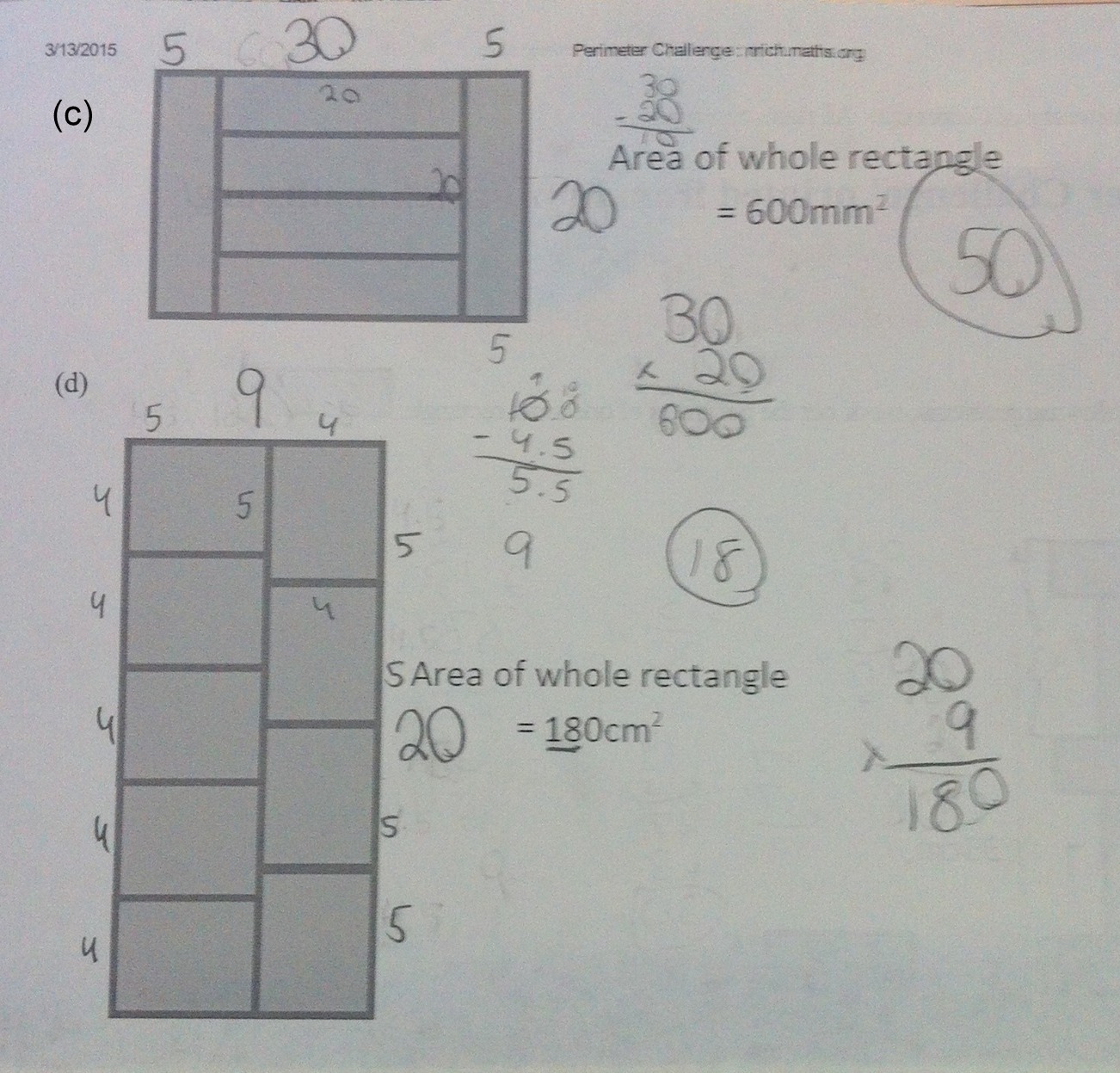
In both of these problems he tried to solve them by guessing dimensions and then checking whether they matched the picture (like 4 would visually be a smaller side than 5). Unfortunately he erased the dimensions that were wrong, so all that's left is the answer that he thought was correct. But I know from sitting with him as he worked through the problems his method was to guess dimensions, like he guessed 10x18 for the bottom picture, and then to check whether it was correct. So for the bottom one he determined 10x18 was wrong because he couldn't divide 18 (along the vertical side) into four equal integers, which represented the long side for the small rectangles.
I think this is interesting because I have learned that the most efficient way to solve a problem like this is to use algebra. So I would label the long side of each small rectangle as x and each shorter side as y and have equations like (x+y)(4x)=180 and 5y=4x, then solve for x and y to get x=5, y=4. This eliminates the possibility of having multiple guesses and having only my eyes to approximate the distances drawn. So while the student was looking at the lengths to see if his answers could make sense, his guesses would've been completely thrown off if the distances weren't drawn to scale. It could have dramatically changed his answer, whereas my answer using algebra would've remained the same and I would still be confident in my answer once I checked whether my math was correct when solving for the variables.
I also think this was eye-opening because he's in Algebra 1 and he has done problems out of the book for months now that use variables and solving systems and creating systems based on story problems. However, he was unable to apply that knowledge to these interview problems. So has he really learned how to use variables? I would lean towards no, he has not mastered the concept. He can do problems that solve for variables, but he cannot apply that to new problems which have no suggestion for how to solve them. However, to be fair it could be that he preferred to guess and check just because that's more comfortable for him and perhaps since I did not tell him how to solve it he didn't even bother with thinking about variables. Either way I think this is a great set of problems to check students understanding of variables or to even introduce the topic of variables. I knew that it wasn't fun for him to try all those different dimensions so it could be a great way to force the topic of algebra so that he could solve this problem once using variables and be done.
Tuesday, March 24, 2015
Origami and Math
This blogpost is inspired by the Ted talk by Robert Lang called The Math and Magic of Origami.
Origami is the ancient art form of folding a single sheet of paper to create objects. You can make animals, hearts, boxes, the list never ends. In fact, the amount of objects that could be made with origami exploded once people incorporated math. So why not incorporate origami in the math class?
Not only would students learn about an ancient culture, but it will teach them some properties about geometry and it will be super engaging because students will be able to make their own creation. Also, origami is great because if you mess up you just unfold it and try again. And students could probably choose their own figure to make, so it would allow for different levels of skill. In fact I could see making a project that would include a part about learning about the culture surrounding origami, then making an origami figure and explaining the math behind their figure. For example, Robert Lang talks about numbering the angles around the center circle and seeing that after folding, the odd numbered angles would add to be a line and the even numbered angles would add to be a line. I think this is super interesting and it would be interesting to ask students to find angle measures based on how many folds there are.

You could also have the students examine the crease patterns (the flat unfolded page that was once folded) and ask if there are any congruent shapes and why. Are there any similar shapes? You could also have them take a ruler to the paper and ask them area of different shapes in the crease pattern as well as perimeter. I think there are a lot of skills that could be practiced by doing this origami.
Robert Lang also discusses applications of origami in the real world. Some examples he discusses are heart stints and telescopes. I think it would be a great idea to have students work in pairs and present on a real application of origami that uses math properties that we had talked about in class.
I think this would be a really fun and engaging way to talk about shapes and geometry while learning a skill that students can be proud of. It also provides a way to learn about another culture which will help students become better citizens of the world. With the added component of researching a real life application of origami, we are also extending what we have learned and seeing how these things really matter, which is something a lot of math classes don't address. Overall, I think it's a very interesting application of math and creates such beautiful objects.
Happy folding!
Origami is the ancient art form of folding a single sheet of paper to create objects. You can make animals, hearts, boxes, the list never ends. In fact, the amount of objects that could be made with origami exploded once people incorporated math. So why not incorporate origami in the math class?
Not only would students learn about an ancient culture, but it will teach them some properties about geometry and it will be super engaging because students will be able to make their own creation. Also, origami is great because if you mess up you just unfold it and try again. And students could probably choose their own figure to make, so it would allow for different levels of skill. In fact I could see making a project that would include a part about learning about the culture surrounding origami, then making an origami figure and explaining the math behind their figure. For example, Robert Lang talks about numbering the angles around the center circle and seeing that after folding, the odd numbered angles would add to be a line and the even numbered angles would add to be a line. I think this is super interesting and it would be interesting to ask students to find angle measures based on how many folds there are.
You could also have the students examine the crease patterns (the flat unfolded page that was once folded) and ask if there are any congruent shapes and why. Are there any similar shapes? You could also have them take a ruler to the paper and ask them area of different shapes in the crease pattern as well as perimeter. I think there are a lot of skills that could be practiced by doing this origami.
Robert Lang also discusses applications of origami in the real world. Some examples he discusses are heart stints and telescopes. I think it would be a great idea to have students work in pairs and present on a real application of origami that uses math properties that we had talked about in class.
I think this would be a really fun and engaging way to talk about shapes and geometry while learning a skill that students can be proud of. It also provides a way to learn about another culture which will help students become better citizens of the world. With the added component of researching a real life application of origami, we are also extending what we have learned and seeing how these things really matter, which is something a lot of math classes don't address. Overall, I think it's a very interesting application of math and creates such beautiful objects.
Happy folding!
Subscribe to:
Posts (Atom)